

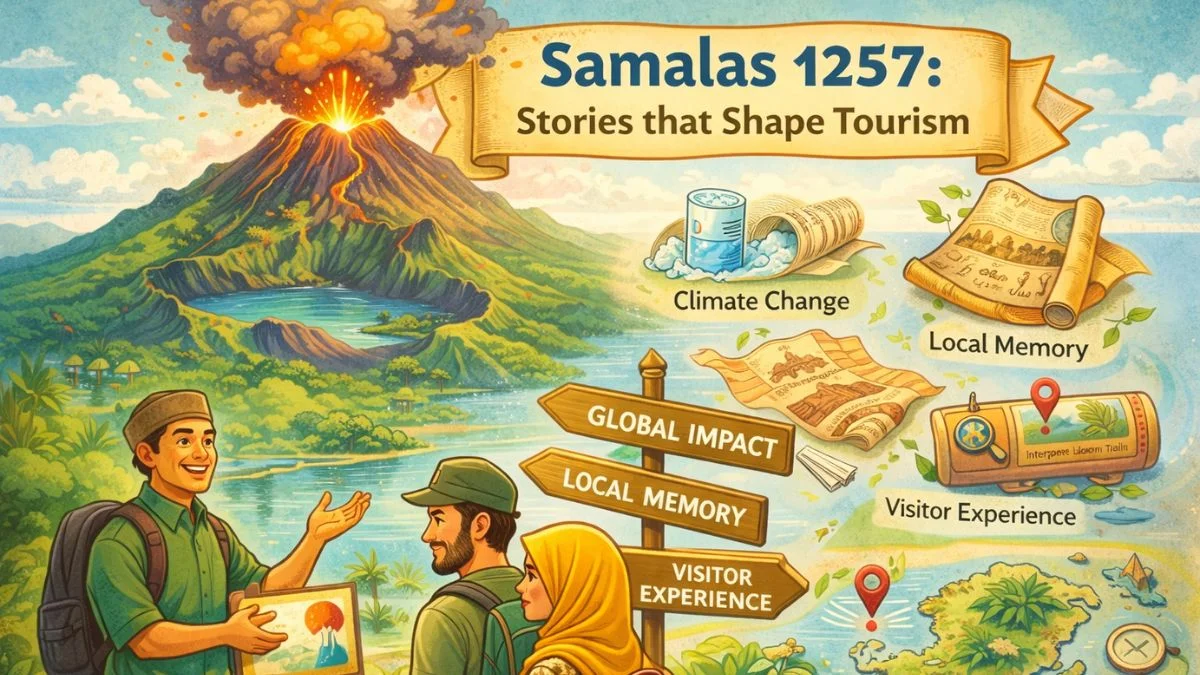
Samalas 1257: Stories that Shape Tourism
When a Volcano Changed the World: Reframing Samalas 1257 as the Heart of Lombok’s Geotourism Story
More than seven centuries ago, a volcano on the island of Lombok reshaped not only its own landscape, but the climate, history, and human experience of much of the world. The eruption of Mount Samalas in 1257 CE—now recognized as one of the largest volcanic events of the last 10,000 years—has long remained fragmented across scientific journals, historical chronicles, and local oral traditions. Today, new research argues that this fragmentation is precisely what limits Lombok’s tourism potential—and that the Samalas eruption should instead be positioned as a unifying narrative for the future of Geopark Rinjani-Lombok.
This study does not treat Samalas merely as a geological curiosity. It approaches the eruption as a powerful “geo-story”: a convergence of earth science, climate history, cultural memory, and human resilience that can be transformed into a high-value, experience-based tourism model through a storynomics approach.
A Local Eruption with Global Consequences
Scientific consensus now confirms that the Samalas eruption reached Volcanic Explosivity Index (VEI) 7, ejecting more than 40 km³ of magma and sending sulfur-rich aerosols into the stratosphere. Ice core records from Greenland and Antarctica, tree-ring data from multiple continents, and medieval European chronicles all independently trace the same signal: abrupt global cooling, failed harvests, famine, and social unrest during 1258–1259.
In modern terms, Samalas represents an early example of global interconnection—long before globalization was a concept. A single volcanic event in Lombok altered atmospheric systems, disrupted food security in Europe, and left chemical fingerprints at the planet’s poles. Few destinations in the world can claim such scientifically verified global relevance rooted in a single location.
Yet despite this extraordinary significance, Samalas remains largely invisible in how Lombok presents itself to visitors.
Between Rinjani and Mandalika: A Story Left Untold
Tourism development in Lombok has progressed rapidly, but unevenly. The Rinjani area emphasizes physical landscapes and adventure, while Mandalika foregrounds cultural symbolism and contemporary branding. What is missing is a narrative bridge—a master story capable of connecting geology, culture, and modern identity.
The research identifies this as a structural gap. Existing geotrails, visitor routes, and destination clusters focus on “what can be seen” rather than “what can be understood.” Geological sites are presented as scenery, while cultural destinations often detach themselves from the deep-time processes that shaped Lombok itself.
Samalas offers a solution to this fragmentation. As both a geological origin story and a human survival story, it has the rare capacity to function as a narrative backbone for the entire island.
From Disaster to Meaning: Why Samalas Resonates
What makes the Samalas story particularly powerful is not only its scale, but its transformation arc.
Local historical sources, such as Babad Lombok and Babad Suwung, recount the destruction of the Pamatan Kingdom, mass displacement, and a recovery process that unfolded over generations. These accounts humanize the catastrophe, framing it not simply as an eruption, but as a turning point in Lombok’s cultural memory.
At the same time, modern hydrogeological studies reveal a striking paradox: volcanic deposits from the eruption later formed the main freshwater aquifers sustaining present-day Mataram. The same event that erased a kingdom ultimately enabled new life.
This duality—destruction and renewal—gives Samalas exceptional narrative depth. It is not a story of tragedy alone, but of resilience, adaptation, and long-term coexistence between humans and a volatile planet.
Introducing Storynomics to Geotourism
The research proposes that Lombok’s challenge is not a lack of attractions, but a lack of narrative architecture. Drawing on experience economy theory and storynomics tourism, the study reframes tourism value as something created through meaning, emotion, and transformation—not just visual consumption.
Within this framework, Samalas becomes the “core saga” of Geopark Rinjani-Lombok: a scientifically grounded, emotionally resonant storyline that can be translated into guided experiences, interpretive trails, digital platforms, community storytelling, and cultural products.
Rather than adding another attraction, this approach reorganizes existing ones under a shared storyline—allowing visitors to experience Lombok not as a collection of sites, but as a coherent journey through time, risk, and resilience.
The SAGAS Model: Turning Science into Experience
To operationalize this vision, the study introduces the SAGAS Model (Samalas Geo-heritage Adaptive Storytelling). The model emphasizes five interconnected elements:
A Core Narrative rooted in verified science and local memory
Experience Arenas that engage visitors intellectually, emotionally, and sensorially
Narrative Infrastructure, from trained storytellers to interpretive design
Collaborative Governance involving communities, scientists, and destination managers
Adaptive Feedback, ensuring stories evolve with new knowledge and visitor insights
The goal is not dramatization without substance, but credibility-driven storytelling—where every experience remains accountable to science, history, and conservation ethics.
Why This Matters Now
As Geopark Rinjani-Lombok moves toward global recognition, differentiation becomes critical. Many destinations offer volcanoes, mountains, or beaches. Very few can offer a scientifically proven event that altered global climate, reshaped human history, and still defines everyday life through water, land, and memory.
Positioning Samalas at the center of Lombok’s geotourism strategy is not about revisiting the past for nostalgia’s sake. It is about redefining how destinations communicate value in an era where travelers increasingly seek meaning, learning, and connection.
Samalas reminds us that landscapes are not passive backdrops. They are active agents in human history. By telling that story well—and responsibly—Lombok has the opportunity to become not just a place to visit, but a place to understand.
The full journal article is available for download via the link provided, offering detailed theoretical foundations, literature synthesis, and the complete SAGAS model for practitioners, policymakers, and researchers.