

Greenwashing Threatens Sustainable Mangrove Ecotourism in Indonesia
A rigorous new study from Indonesia employs advanced social and ecological theory to dissect a growing problem in climate conservation: the gap between environmental storytelling and scientific reality, known as “greenwashing.”
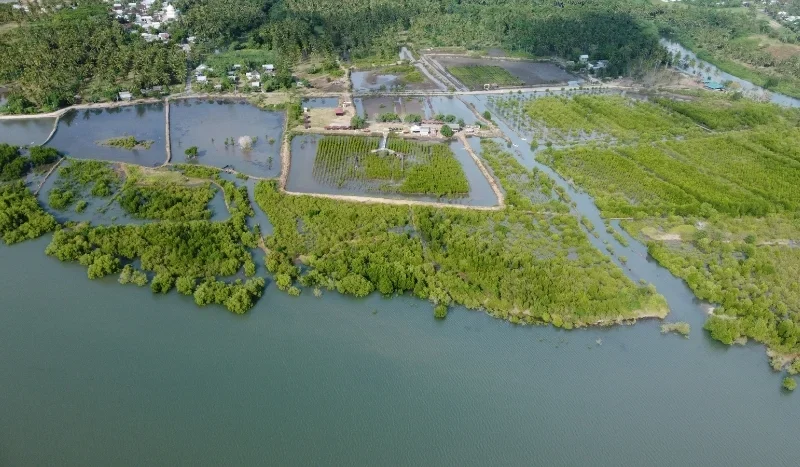
The research, focused on the Bagek Kembar Mangrove Ecotourism site in West Lombok, moves beyond simple observation. It uses a dual theoretical framework to first measure the physical health of the mangrove forest and then deconstruct the public narrative surrounding it, revealing a profound and systemic disconnect.
The Scientific Benchmark: Ecological Mangrove Restoration (EMR)
At its core, the study uses Ecological Mangrove Restoration (EMR) as its scientific benchmark. Unlike conventional planting drives, EMR is a theory-based framework that emphasises restoring the conditions for mangroves to thrive naturally, fixing water flows, ensuring correct species zonation, and allowing natural regeneration. It is the gold standard for sustainable, long-term recovery.
The data, comparing EMR-managed zones with areas run for commercial tourism, validated the theory’s importance with stark results:
-
EMR zones showed 40% higher carbon stocks and 30% greater species diversity.
-
Seedling survival rates were 85% under EMR, collapsing to 65% in commercially managed plots.
-
Seedling density, a key indicator of future resilience, was nearly double in the science-led areas.
“The data articulates a simple truth,” one researcher stated. “The EMR framework isn’t just academic; it writes resilience directly into the landscape. Ignoring its principles leads to a fundamentally weaker ecosystem.”
Deconstructing the “Green” Narrative: Critical Discourse Analysis (CDA)
Where the study breaks new ground is in its application of Critical Discourse Analysis (CDA). This theoretical approach from sociology and linguistics treats language not as neutral description, but as a tool that shapes perception, builds power, and can legitimise certain realities over others.
Applying CDA to promotional websites, social media posts, and brochures, researchers found a carefully constructed narrative. Phrases like “pristine green paradise” and “comprehensive ecological restoration” dominated. Visually, imagery was selectively curated from the healthiest sectors.
The analysis concluded this was not mere promotion, but the creation of a “symbolic veneer”, a coherent story of achieved sustainability that, according to the theory, serves to build legitimacy, attract visitors, and secure social license. This constructed narrative, the study argues, actively obscures the on-ground variability and the significant superiority of the EMR-managed plots.
The Dangerous Gap: Where Theory Meets the Muddy Ground
The study’s power lies in forcing these two theoretical lenses, the ecological (EMR) and the sociological (CDA), to confront each other.
The tension is acute. Interviews with managers revealed the structural drivers behind the glossy narrative: financial pressure, competition for tourists, and the need for positive publicity often lead to claims being “overstated.” This creates a self-perpetuating cycle where marketing accelerates ahead of measurable, science-led recovery.
More alarmingly, this “greenwashed” narrative was found to be a smokescreen for ongoing degradation. The CDA of promotional materials showed a complete omission of documented threats like illegal logging and water pollution from upstream gold mining, issues recorded by ecological surveys but absent from the eco-brand.
“This is greenwashing in its most consequential form,” the lead author explained. “It’s not just an exaggerated claim. It’s the use of a sustainability discourse, rooted in powerful words and imagery, to divert attention from active environmental harm and from the demonstrably better scientific practices available.”
Global Stakes and an Imperative for Integrity
The implications resonate globally. Indonesia’s mangroves are a cornerstone of the world’s “blue carbon” strategy for climate mitigation. Authentic eco-tourism could be a vital engine for their conservation.
This study, however, theorises that without integrity, the model collapses. If the discourse of “eco-” becomes detached from the science of “ecology,” it risks eroding public trust, misallocating resources, and ultimately sanctioning the degradation of the very ecosystems it markets.
The research prescribes a path forward grounded in its own theoretical rigor: a new model of “verified eco-tourism” where:
-
Promotional discourse is transparently tied to standardized ecological metrics (like EMR scores).
-
Communication honours the long-term, often non-photogenic, process of scientific restoration.
-
Governance systems are created to validate claims, moving beyond symbolism to measurable, science-based accountability.
For Indonesia and the global communities investing in nature-based climate solutions, the study delivers a critical lesson: the stories we tell about saving the planet must be rooted in the science of how the planet actually works. The future of these vital coastal forests may depend on closing that theoretical gap.
Author: Fuad Andhika Rahman