

Emotional Solidarity Phenomenology in Lombok Tourism
Beyond Good Intentions: How Emotional Bonds Shape the Real Impact of Voluntourism in Lombok
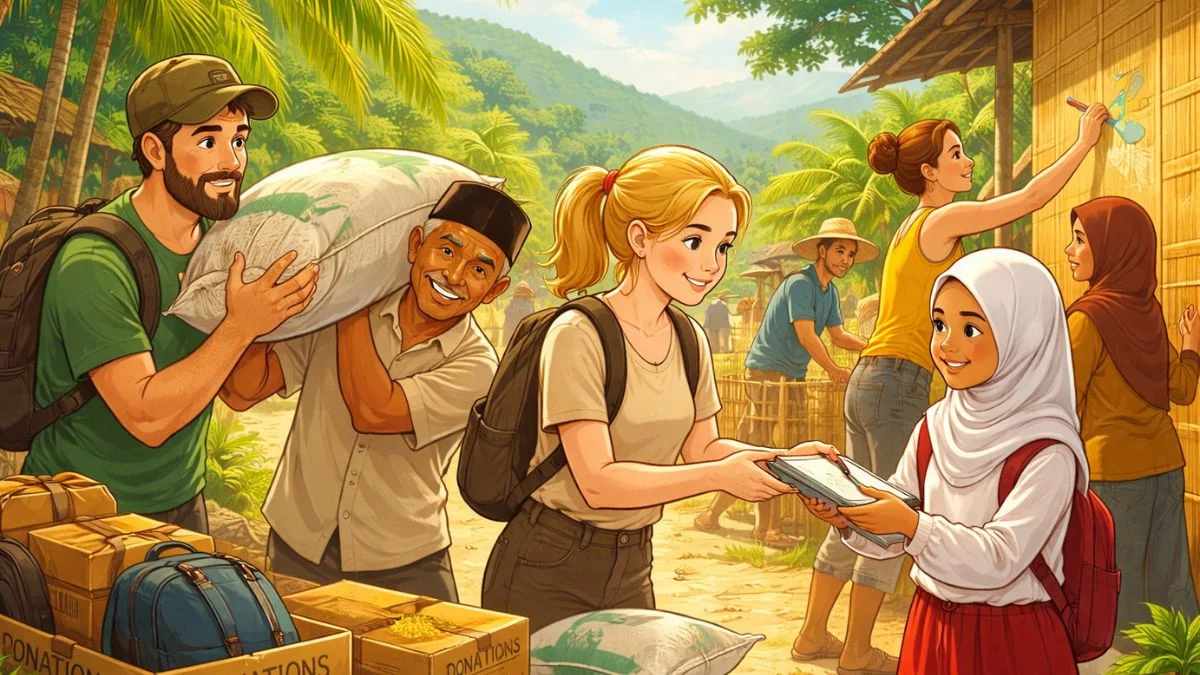
Voluntourism is often celebrated as the ethical face of tourism—where travelers do more than consume places, choosing instead to contribute time, skills, and empathy. In Lombok, this model has expanded rapidly through digital platforms such as Workaway and Worldpackers, connecting international volunteers with local homestays, schools, and community initiatives. Yet a fundamental question remains largely unanswered: does voluntourism truly redistribute economic benefits to local communities, or does it quietly reproduce the same inequalities found in mass tourism?
A new doctoral research project confronts this question directly by shifting attention away from activities and intentions, and toward something far less visible but far more decisive: emotional solidarity between volunteers and host communities.
The Hidden Variable in Voluntourism Success
Tourism development in Lombok mirrors a broader pattern seen across many emerging destinations. While visitor numbers grow and new “alternative tourism” labels proliferate, economic benefits remain unevenly distributed, often concentrated among a small group of actors. Voluntourism is frequently positioned as an antidote to this problem—grassroots, participatory, and morally grounded.
However, empirical evidence linking voluntourism to fairer economic outcomes has been thin. Much of the existing literature focuses on volunteer motivation, personal transformation, or cultural exchange. What happens after emotional connections are formed—and whether those connections translate into tangible economic flows—has received far less scrutiny.
This research argues that the missing link lies in emotional solidarity: the sense of closeness, mutual understanding, and feeling welcomed that develops through sustained interaction between volunteers and local residents.
From Feelings to Flows: A Socio-Economic Lens
Drawing on Emotional Solidarity Theory, the study reframes voluntourism not as a purely altruistic act, but as a social process embedded in political and economic structures. Emotional bonds are treated not as by-products of volunteering, but as social capital—resources that can activate trust, reciprocity, and ultimately economic behavior.
The research proposes a clear causal pathway:
Emotional solidarity → trust and reciprocity → local economic distribution
Trust reduces uncertainty and encourages volunteers to spend locally, choose community-run services, and commit resources beyond the minimum. Reciprocity introduces a moral dimension: volunteers feel compelled to “give back” in ways that exceed transactional exchange, whether through spending, skill transfer, or unpaid labor that can be economically valued.
Importantly, these processes are examined within Lombok’s broader political-economic context, where oligarchic structures often limit who benefits from tourism growth. Voluntourism, the study suggests, may function as a rare micro-level mechanism capable of partially bypassing these structural barriers—but only when emotional solidarity is genuinely present.
Measuring What Is Usually Ignored
Methodologically, the research adopts a mixed-methods approach to move beyond anecdote. A large-scale survey of volunteer tourists quantitatively measures emotional solidarity, trust, reciprocity, and spending patterns using Structural Equation Modeling. This is complemented by in-depth interviews and participatory observation that explore how these relationships are experienced and negotiated on the ground.
Crucially, the study does not limit economic impact to direct spending. Indirect contributions—such as teaching, environmental rehabilitation, and skills training—are converted into monetary values using expenditure mapping and replacement cost methods. This allows the research to capture the full spectrum of value created through voluntourism, much of which is usually invisible in tourism statistics.
Challenging the “Feel-Good” Narrative
One of the study’s central interventions is its critique of the assumption that voluntourism is inherently fair or transformative. Emotional engagement alone does not guarantee equitable outcomes. When trust is weak, relationships are short-term, or programs are embedded in extractive tourism structures, voluntourism risks becoming symbolic—producing emotional satisfaction for volunteers without meaningful redistribution of benefits.
Conversely, when emotional solidarity is strong and mediated by trust and reciprocity, voluntourism shows measurable potential to redirect economic flows toward local households and small enterprises. In this sense, emotions are not soft variables—they are structural forces with economic consequences.
Why Lombok Matters
Lombok provides a critical testing ground for this argument. Positioned as an alternative to Bali yet shaped by similar political-economic dynamics, the island exemplifies the tension between inclusive tourism narratives and concentrated benefits. The rapid growth of platform-based voluntourism makes Lombok especially relevant for understanding how digital intermediation reshapes host–guest relationships.
By grounding its analysis in Lombok’s lived realities, the research speaks not only to academic debates, but to policymakers, community leaders, and tourism practitioners searching for models that move beyond growth toward justice.
Toward a More Accountable Voluntourism Model
The study ultimately calls for a shift in how voluntourism is governed and evaluated. Success should not be measured by volunteer numbers or activities completed, but by the quality of relationships formed and the economic pathways those relationships enable. Emotional solidarity, when recognized and cultivated deliberately, becomes a policy-relevant variable—not a sentimental afterthought.
In an era where ethical tourism claims are easy to make and hard to verify, this research offers a sobering but constructive message: voluntourism only becomes transformative when emotions translate into structures, and solidarity into distribution.
The full research proposal and theoretical framework are available for download via the link provided, offering detailed methodological design, hypotheses, and governance implications for developing more just and sustainable voluntourism in Lombok.